
Hello readers!
I’ve created a new page to keep all of my posts about the charity shop cards together. Please enjoy, and check in for new updates.
The Japanese Posties
Hello friends.
Apologies for not being ‘online’ recently, but I have a good excuse. If you will recall, I posted some Japanese cards not too long ago [
https://www.instagram.com/p/BwsJZFgl-oD/?utm_source=ig_web_button_share_sheet ], and they have been keeping me very busy. I’ve posted them below for your perusal. See you at the bottom!

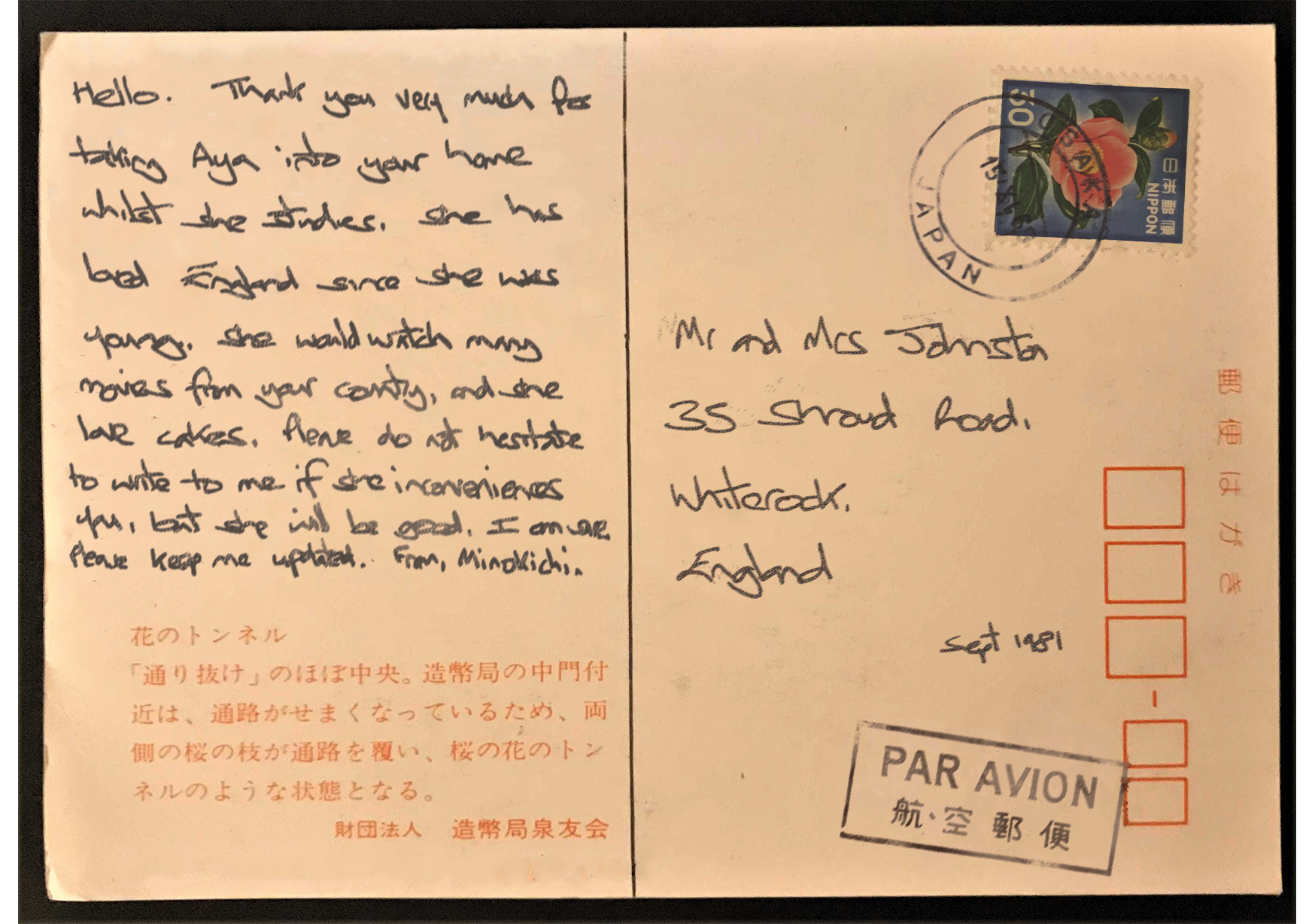
This one reads:
‘Hello, thank you very much for taking Aya in to your home whilst she studies. She has loved England since she was young. She would watch many movies from your country, and she love cakes. Please do not hesitate to write to me if she inconveniences you, but she will be good, I’m sure. Please keep me updated.
From, Minokichi’

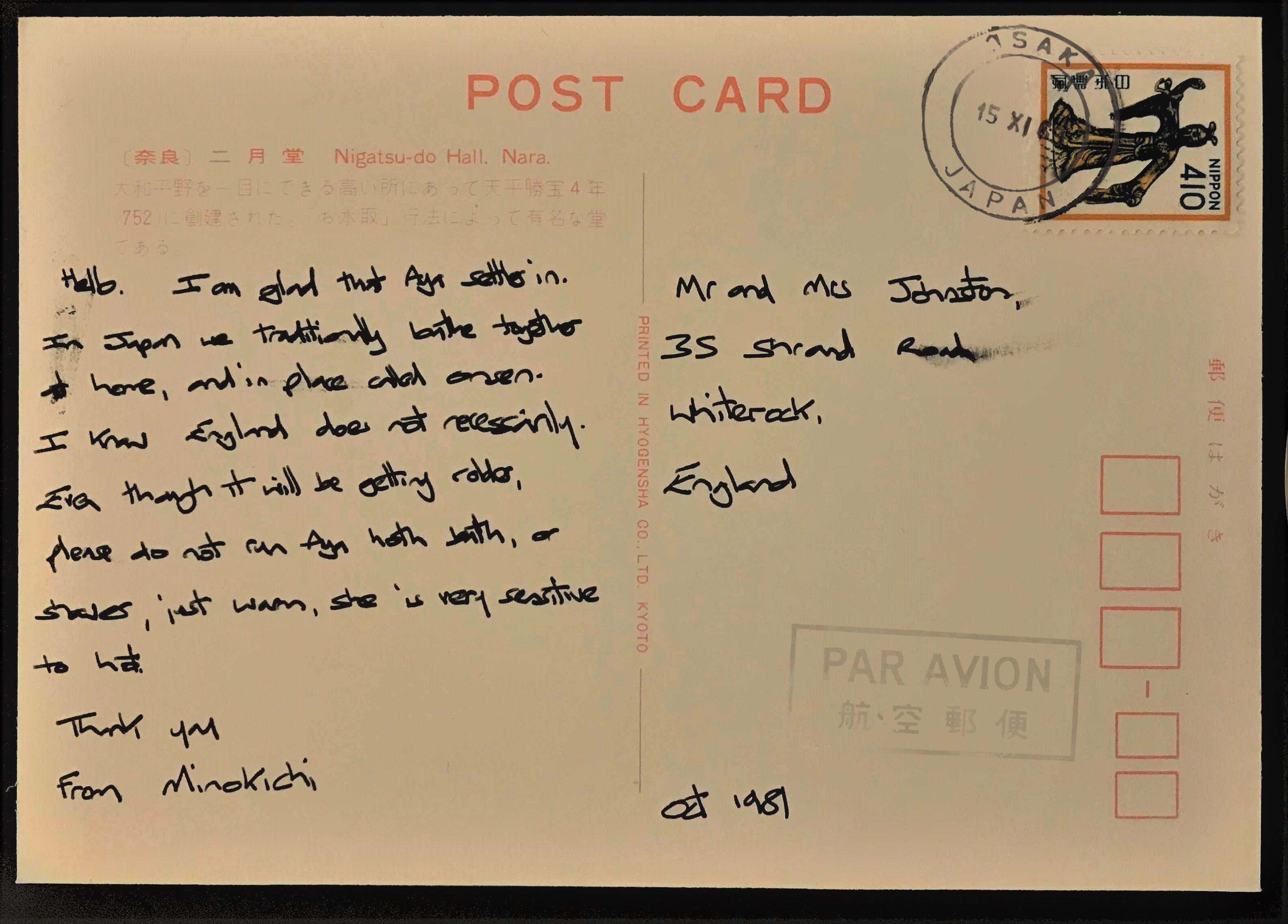
This one reads:
‘Hello. I am glad that Aya settles in. In Japan, we traditionally bathe together at home, and in place called onsen. I know England does not necessarily. Even though it will be getting colder, please do not run Aya hot bath, or shower, just warm, she is very sensitive to hot. Thank you.
From, Minokichi.’

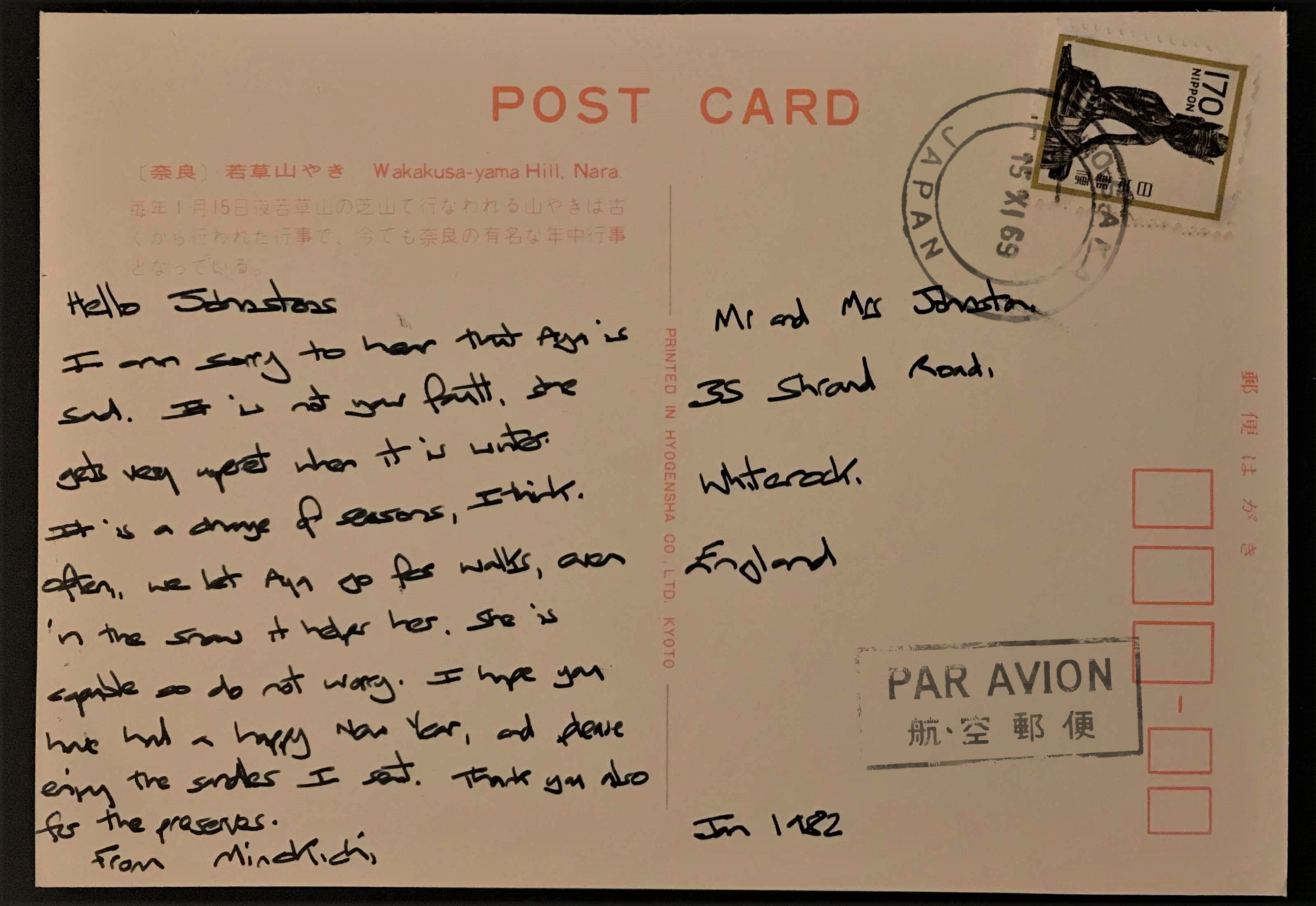
This one reads:
‘Hello Johnstons. I am sorry to hear that Aya is sad. It is not your fault, she gets very upset when it is winter. It is a change of seasons, I think. Often, we let Aya go for walks, even in the snow it helps her. She is capable so do not worry. I hope you have had a happy new year, and please enjoy the sandals I sent. Thank you also for the preserves.
From, Minokichi.’

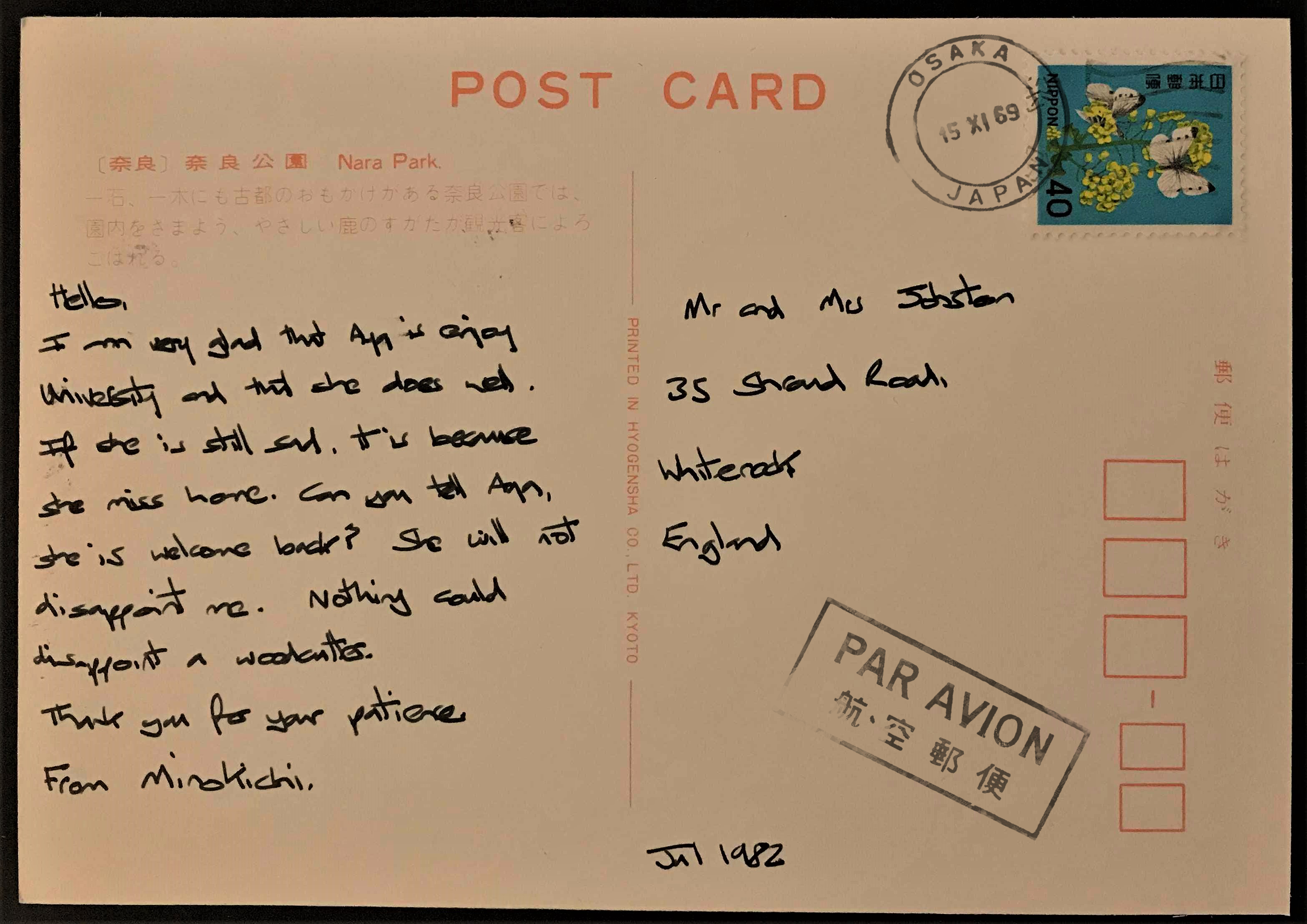
This one reads:
‘Hello. I am very glad that Aya is enjoy university and that she does well. If she is still sad, it is because she misses home. Can you tell Aya, she is welcome back? She will not disappoint me. Nothing could disappoint a woodcutter. Thank you for your patience.
From, Minokichi.’

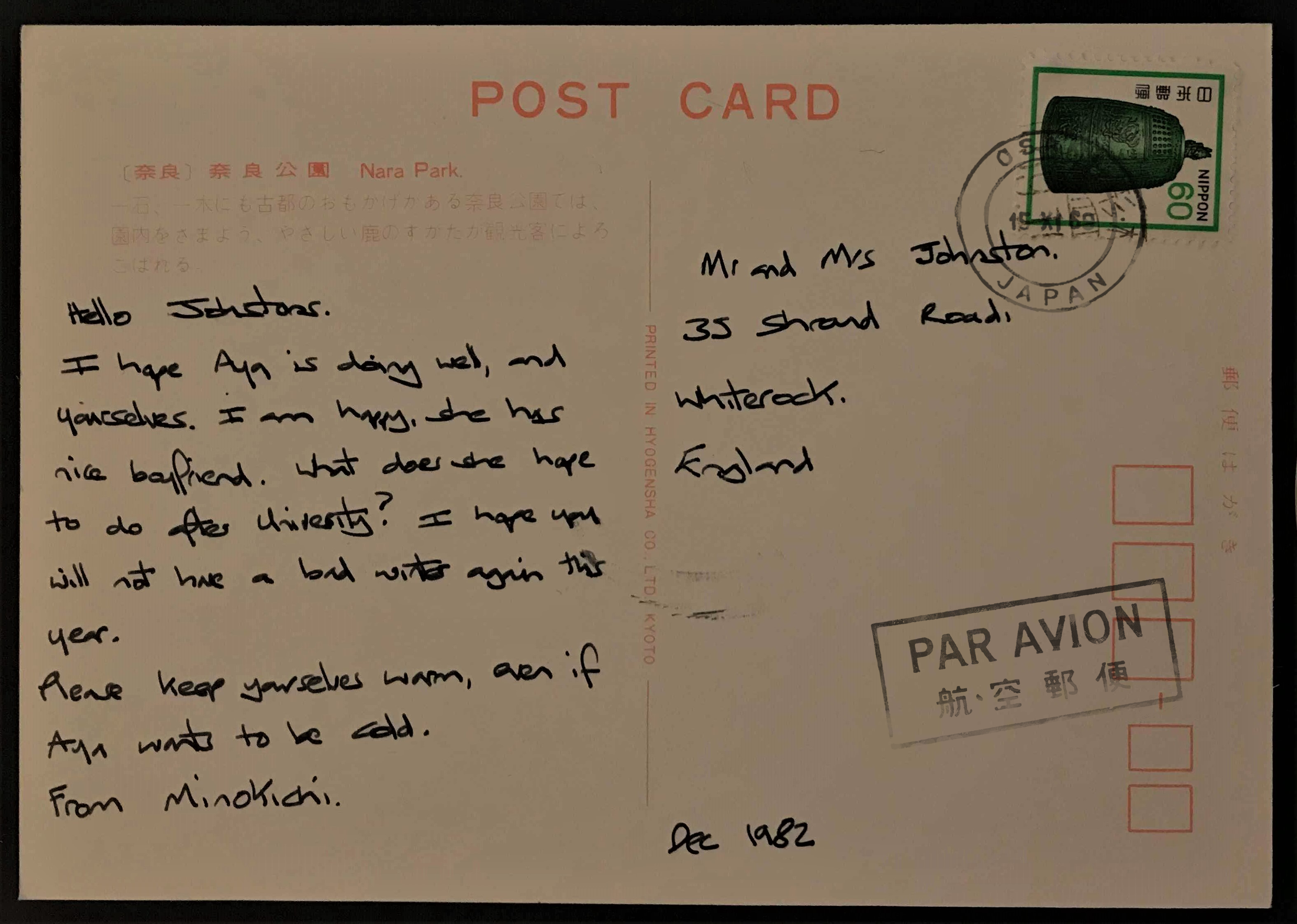
This one reads:
‘Hello Johnstons. I hope Aya is doing well, and yourselves. I’m happy she has nice boyfriend. What does she hope to do after university? I hope you will not have a bad winter again this year. Please keep yourselves warm even if Aya wants to be cold.
From, Minokichi.’

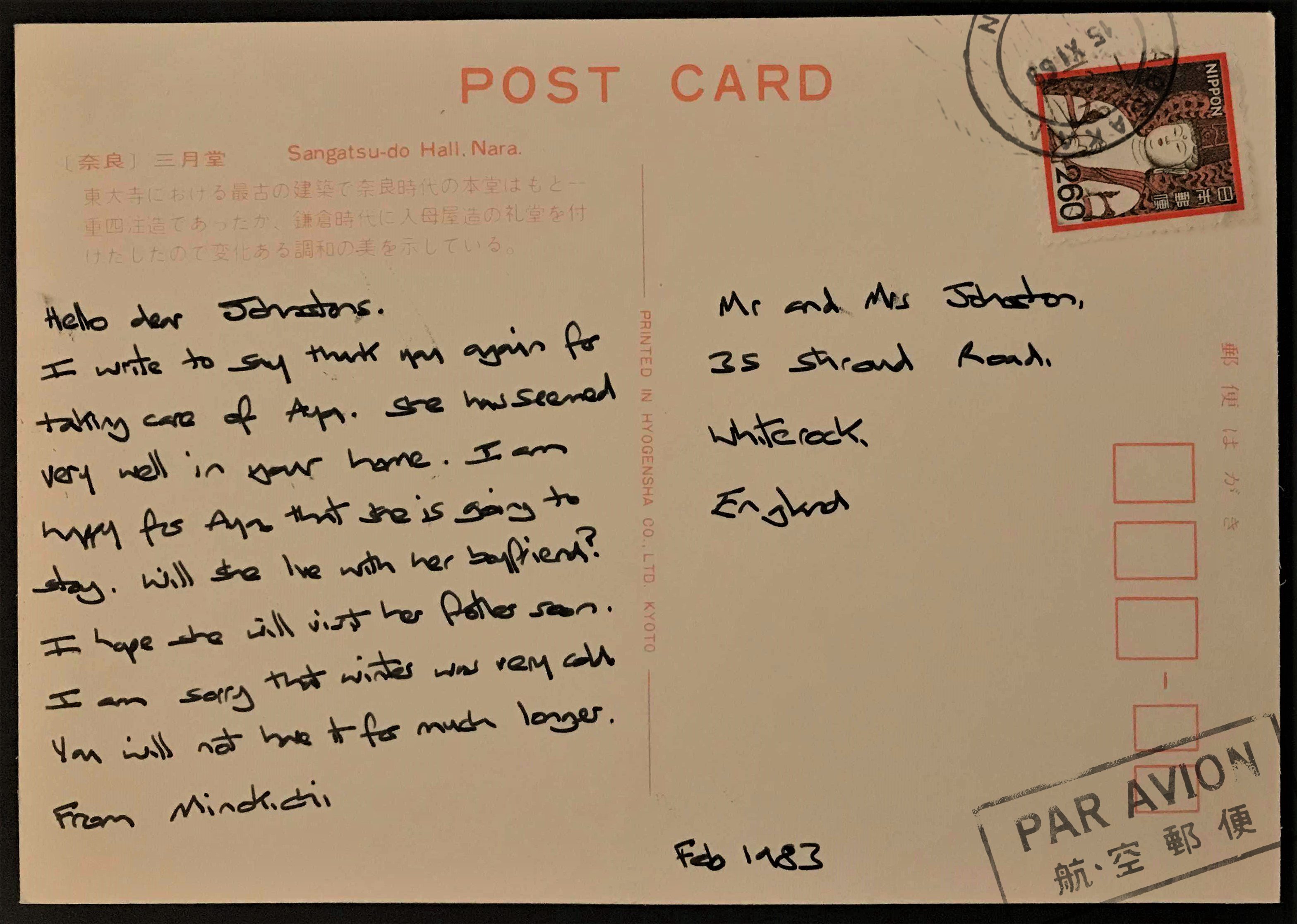
This one reads:
‘Hello, dear Johnstons. I write to say thank you again for taking care of Aya. She has seemed very well in your home. I am happy for Aya, that she is going to stay. Will she live with her boyfriend? I hope she will visit her father soon. I am sorry that winter was very cold. You will not have it for much longer.
From, Minokichi.’

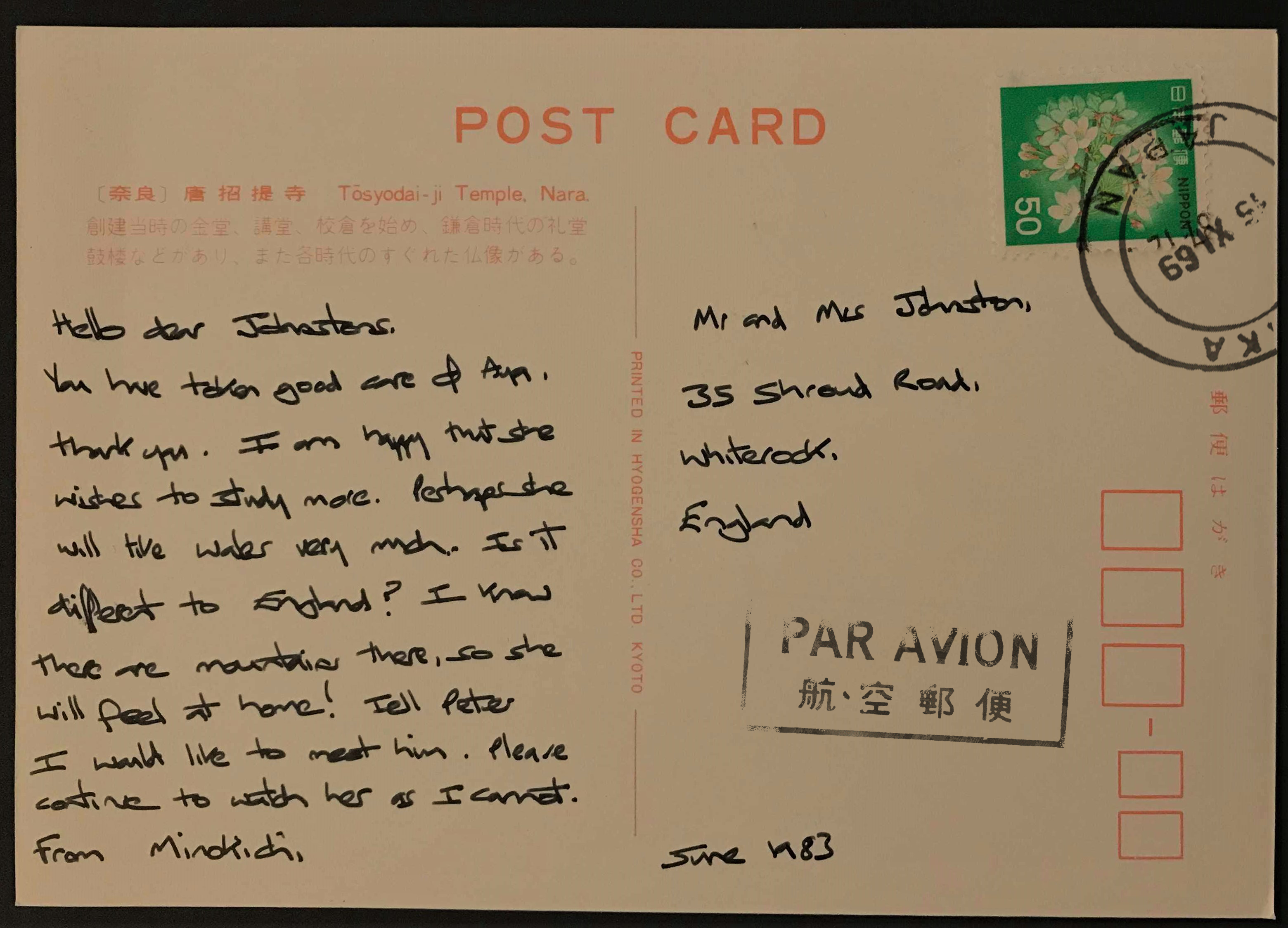
This one reads:
‘Hello, dear Johnstons. You have taken good care of Aya. thank you. I am happy that she wishes study more. Perhaps she will like Wales very much. Is it different to England? I know there are mountains there, so she will feel at home! Tell Peter I would like to meet him. Please continue to watch her, as I cannot.
From, Minokichi.’
You must have questions! Who is this Aya? I want to hazard a guess that she must be around my age now. I’m intrigued to know what she has been up to all these years, aren’t you? And my, what beautiful cards. But firstly, some information.
As you may have noticed, these gems are dated between 1981 and 1983. This is verified by the stamps, which were also made in the early 80’s. The cards between 2 and 7 also appear to be from Nara Park. I presume that our friend Minokichi must have purchased a set from there at one time or another. As to where Minokichi is himself located, I cannot be sure. It is possible that he is from Osaka, as suggested by the franking. But of course, mail is delivered all over! Perhaps the card simply passed through there. I am still learning about the fascinating world of postcards.
So! I shall explain myself. I have been searching for Aya. It is fortunate that my little village is indeed so very little. Though I never met the family these cards were addressed to, I had heard of the Johnstons a good number of years ago as they were active community members. Unfortunately, upon searching them out, I discovered that they had both recently been moved to a care home. Their son, David, has since moved in to their house. He was very helpful however and provided me with Aya’s last known address…and that is exactly where I have been, deep in the mountains of South Wales!
I shall be writing another post soon, which tells all about Aya from Aya herself. What do you think of these cards? Let me know.
Kit.
P.S. For those worrying, it’s all above board! Both Aya and David have consented to this article being written and to the cards being shown.
The Life of a Postcard

Hello friends.
As you may have seen, I recently found some forty year old postcards from Japan, which you can read all about here: [
https://kitspost.home.blog/2019/05/02/the-japanese-posties/]. Interestingly, all seven are addressed to the same family, spanning a time of two years. The writer, a man named Minokichi often asked after his daughter, Aya. This is completely new to me, as my collection has only thus far included clean postcards. But haven’t you ever wondered what would happen if you found the people in these cards? Well I took it upon myself to find out!
For those who may be wondering why it has taken so long for me to post this, my editor expressed interest in the project and asked that I publish it in the Whiterock Wrap first. We agreed that after it’s printing and delivery, I could pop the article on my blog. So here it is! Without further ado, please enjoy!
—
In the age of social media, the need for letters and postcards seems to have diminished. Stamps are expensive, and why wait to tell your loved ones about your holiday when you can do it in a flash online? It seems that paper has become a kind of relic. Yet despite this, I find postcards to be irresistibly charming and impossible not to buy. For months I have collected all sorts; from prints to paintings to photographs, even special origami cards. But until a few weeks ago, I had never thought to buy used ones.
Whilst perusing my local charity shop for a new pair of shoes, I was struck by a flash of pink atop a bookcase. It was a stack of postcards, the first of which showed a dense avenue of cherry trees. After each card came an even more fascinating image of a land I had never been to. There were bright fireworks, wide-eyed deer, glowing lanterns and towering temples. These were from Japan, I guessed. So what were they doing in England?
‘Hello,’ one began, ‘thank you very much for taking Aya in to your home whilst she studies.’ I flipped through the cards. In each one, a man named Minokichi asked after his daughter. Under the address read the month and year, the first dated September 1981. The subjects didn’t range too far from Aya, and by June 1983, it seemed that she had decided to stay. Immediately I began to wonder who she was and what her life had been like since then. Though I don’t like to admit my age, I myself was a student at that time. In the past forty years I have moved numerous times, had many jobs and seen many things. So what had Aya been up to? I decided to find out.
After two hours of driving and a long trek through the forest below Mynydd Oer in South Wales, I finally arrived at Aya’s house. The small wooden structure stood to the right of me, the exterior covered in moss and ivy.
‘I grew up in rural Japan, so this is quite normal for me,’ said Aya as she stepped out, ‘This is how I’ve always imagined living.’ Her long, silky black hair drifted behind her. With a grin, she ushered me through the door and towards the kitchen. We made small talk as she brewed peach tea in clay mugs. There were remnants of her old life scattered around her home; woodblock prints adorned the walls and in the centre of the living-room was a well-worn kotatsu table, sans blanket. As we sat down, I pulled the postcards from my bag and passed them to her. Carefully, she examined each one and exclaimed that she never knew her father and host family talked so frequently. ‘I fell out with my dad, not because he was a bad person but because he was overly protective,’ she said. ‘He always made sure he knew where I was and what I was doing, so I felt like I had to get away.’ Aya looked contemplatively out of the window for a few moments. ‘I’m not sure if he’s still alive,’ she whispered.
When she first came to Britain, Aya stayed with the Johnston family in Whiterock. They were well known members of the community, and had often taken in pets, foster kids and exchange students alike. When I asked Aya about her time with them, she described a homely life and praised the Johnstons for their open-mindedness. ‘When I met my first boyfriend, they welcomed him completely,’ she said. ‘We fell in love quickly and decided to live with each other. I missed home but I was desperate to make a new life. I liked it here a lot, so it was no problem for me.’
Aya leaned back towards a pile of photo albums and pulled out a small leathery book. Inside were photos of herself and her boyfriend on trips to Welsh castles. I noted that she had barely aged, and asked her if it was life in the forest that kept her young. She nodded enthusiastically. Whilst I flipped through the book, Aya discussed her life after living with the Johnstons. After her degree had ended, she left their house, citing that she did not want to burden them. Together with her boyfriend Peter, they moved to Cardiff and began working at the university. They were an active couple, and often went for walks in the Brecon Beacons. I noticed that Aya’s house was particularly quiet however, and when I asked her what became of Peter, her tone shifted. ‘He died not too long after we moved in,’ she said. I didn’t want to probe, but I wondered how this must have impacted her. She seemed to read my mind. ‘Obviously I didn’t cope with it. I bought some land in the Mynydd Oer forest and built this house not long afterwards,’ she said. ‘I think I felt guilty.’
It was clear that Aya was still shaken, perhaps causing her to become reclusive. I asked her what she had been doing in the time since, given her isolation. She described her seasonal work as a ranger, which includes maintenance of the forest in winter and ensuring that walkers are safe in summer. In her spare time, she makes wooden wares for the local visitors centre. She pointed to small shed through the window, which I presumed to be her workshop. As it turned out, she was not as lonely as I thought. ‘I see other rangers here almost every day. There’s always something to be done, a road that needs clearing or a sheep that needs rescuing,’ she chuckled. It seemed that despite the tragedy in her life, Aya was determined to find joy.
As I got ready to part ways, a thought popped in to my head. ‘Is there anything you regret?’ I asked. She pondered for a moment. ‘Yes,’ she said. ‘After Peter’s death, I stopped contacting the Johnstons. I didn’t have the energy to write everything I felt. I missed them terribly, but they already had enough going on.’ Before I picked up my bag up, I informed her that the Johnstons were doing well under the care of their son. She smiled, and though it seemed like a sad end to their relationship, there was no doubt in my mind that they would have forgiven her.
Walking back through the forested path I entered in, I thought about the journey this postcard had taken me on. I was lucky that the subject of the cards had been so open to the idea. Aya’s life was just as interesting and as colourful as I had imagined it. Indeed it was also coloured with sadness, but Aya had made perhaps the best of it. I doubt she ever imagined that one day, a stranger would arrive at her door asking about a life only peeked at through postcards. Neither did I. I ended this short journey with a sense that despite how communication changes, our voices will always be important to somebody.
—
That’s it! For those of you in Whiterock, you can find this article in the latest issue of the Wrap. If you would like me to send you a copy, please email me. I hope you’ve enjoyed the conclusion to the story of the Japanese postcards. See you soon!
Kit.
A Twist in the Saga?
Hello friends.
Today at the charity shop I went to purchase some more postcards for my collection. Jose, one of the staff who knows me well saved a card for me. It appears that it is part of the Japanese set I bought some time ago.

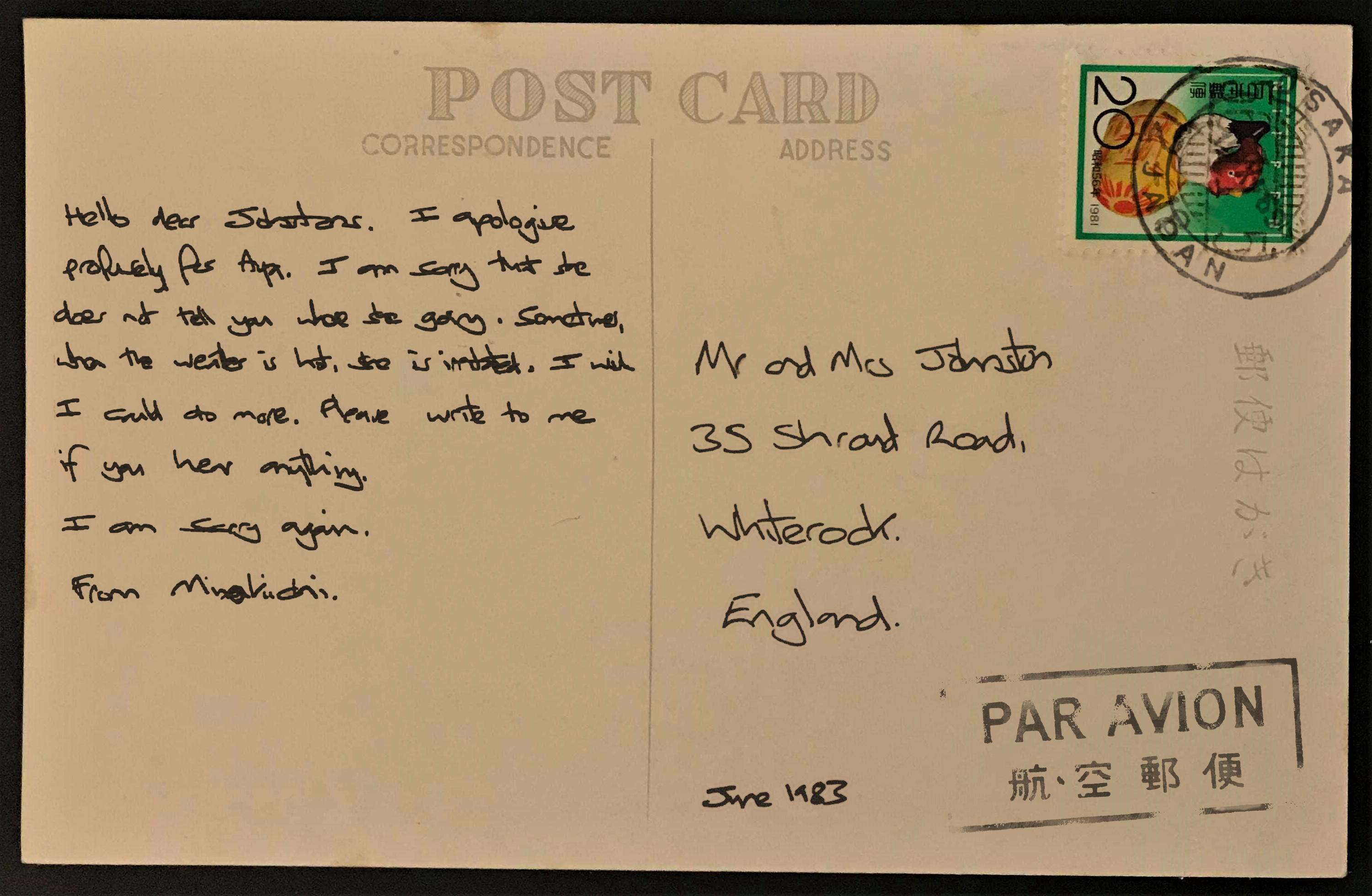
It reads:
‘Hello, dear Johnstons. I apologise profusely for Aya. I am sorry that she does not tell you where she going. Sometimes, when the weather is hot, she is irritated. I wish I could do more. Please write to me if you hear anything. I am sorry, again.
From, Minokichi.’
This particular card appears to have been written about a month after Aya had decided to live with Peter. Indeed, she told me she had left the Johnstons house, but I did not realise she left so abruptly. What do you think? Perhaps her father was simply feeling very worried, or perhaps the sentiment was lost in translation. I think I may have to talk to Aya again. I will send her an email.
Stay tuned.
Kit.
The Life of a Postcard: An Update
Hello friends.
Yesterday, I made my usual visit to the local charity shop. One of the workers who knows me there gave me a postcard that must have fallen out from the Japanese set. After interviewing Aya, the subject of the postcards, I was under the impression that she had parted ways with her host family amicably. However, this new postcard would suggest otherwise. I know this perhaps seems like a trivial detail, but I feel that I have failed to convey the full story. Additionally, though I believed myself to have misunderstood the situation, when I emailed Aya to clear things up, she was not receptive. At the request of some of my readers, I have continued to investigate the story with the Johnston’s son, David.
I shall be brief, as I’m sure we would all like to see a conclusion to this story. A few hours ago I visited the Johnston household. David informed me that although he was young when Aya lived with them, he remembers her as being generally very quiet and polite. However, during her stay, they had two fearsome winters. Naturally, this put everybody in a poor mood, but Aya was particularly difficult. When it came to the central heating, she preferred it to be cold. One morning, the Johnstons awoke to burst pipes and a flooded kitchen ceiling. Aya had turned the heating off. This caused David’s mother to argue badly with her, and later that day, Aya left. A few weeks later, they received a letter which included a formal apology, reparation money and Aya’s new address. However, she did not contact them again, and they did not contact her.
A much sadder end to the story, I believe. I can see why Aya was quiet about this, but I could not leave the story unfinished.
Kit.
A Sad Update
Hello friends.
Today, a reader of mine sent me an email with a clipping on an article. Though I’ve had to censor the photo, I can almost certainly confirm that this is Aya’s boyfriend, Peter. I’ve copied the article out below for ease of reading:

By Thomas Edwards January 1986
‘Mountain rescuers have spent five days searching for a lost couple who had been walking atop Mynydd Oer last week. A sudden snowstorm which caused poor visibility quickly blanketed the terrain, trapping the young couple. The employer of the deceased alerted authorities to his disappearance after he failed to turn up to work two days in a row. Miraculously, rescuers found his partner alive in a rocky crevice. She appears to have no serious injuries. Authorities have warned walkers to be extra careful during the winter season, and to keep to the lower paths of the mountain.’
Aya did not tell me how exactly her boyfriend died and I’m afraid I did not have the resources to find out. Again, I have emailed her for comment but she replied rather rudely. I’m not sure why. The cold weather seems to follow her around.
Kit.
 Kit's Paper and Postcards